
Love is almost always an unpredictable thing, and sometimes Cupid’s arrow strikes us when we are least expecting it. If your fiancé resides in a different country, embarking on the journey of bringing them to the United States to tie the knot is an exciting – but complex – process.
The fiancé visa, also known as the K-1 visa, is designed to bring engaged couples together on U.S. soil. However, navigating the intricacies of this process can be daunting if you don’t have a clear understanding of the steps involved.
In this blog, we will break down the entire process, from filing the initial petition to adjusting status after marriage.
Whether you are in the early stages of this journey and not sure where to start, or are deep into the paperwork and feeling overwhelmed, this comprehensive guide will provide the essential information you need to ensure a smooth and successful visa application experience!
(Note – it is highly advised that you have an attorney guiding you through this complex process to minimize mistakes and overcome obstacles!)
What Is A Fiancé Visa?
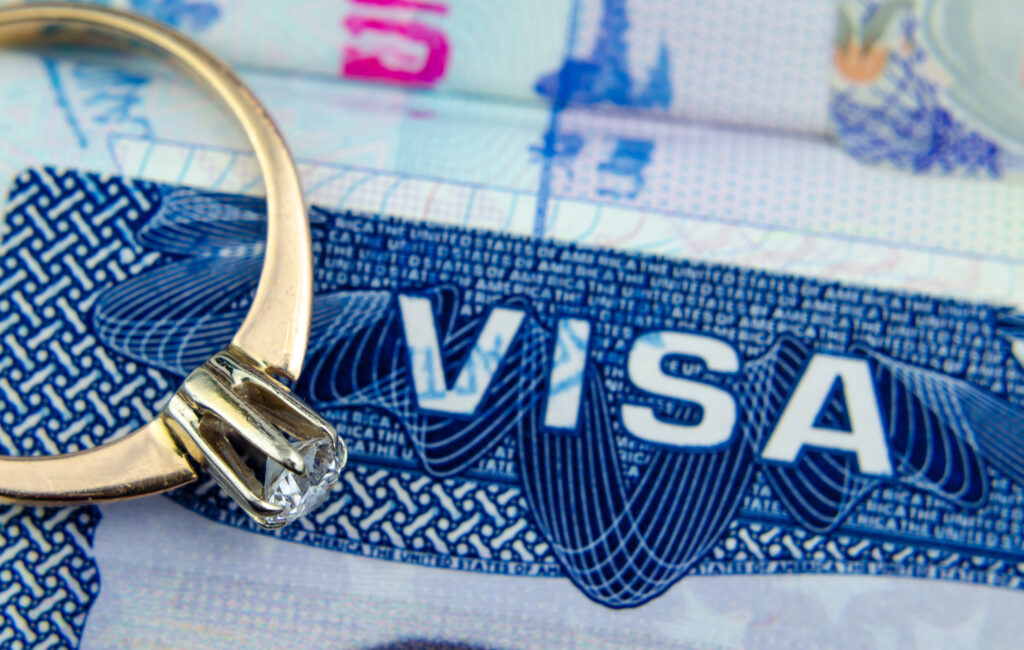
The fiancé visa, officially known as the K-1 visa, is a non-immigrant visa specifically designed to allow foreign nationals who are engaged to U.S. citizens to enter the United States for the purpose of getting married. The visa grants the foreign fiancé the opportunity to travel to the U.S. and marry their U.S. citizen partner within 90 days of their arrival.
Following the marriage, the foreign spouse can then apply for adjustment of status to become a lawful permanent resident (green card holder).
There are eligibility requirements for both the petitioner (the partner who is the U.S. citizen) and the partner who resides in a foreign nation.
For the petitioner:
- Must be a U.S. citizen (green card holders are not eligible to petition for a K-1 visa)
- Must have a legitimate intention to marry the foreign fiancé within 90 days of their arrival
- Must be legally free to marry (i.e., all previous marriages must have been legally terminated by divorce, annulment, or death), and
- Must have met their foreign fiancé in person at least once within the two years leading up to their filing the initial petition (unless meeting in person would violate strict and long-established customs of the foreign fiancé’s culture or would result in extreme hardship to the petitioner).
For the foreign fiancé:
- Must be legally free to marry and free of any impediments
- Must have a legitimate intention to marry the U.S. citizen petitioner within 90 days of entering the U.S. on the K-1 visa, and
- Must demonstrate a legitimate relationship with the petitioner, proven by evidence such as photographs, correspondence, and statements from friends and family.
Initial Steps: Filing The Petition
The K-1 visa process is initiated when the U.S. citizen petitioner files Form I-129F, Petition for Alien Fiance. In this form, you will supply essential information about yourself, as well as your fiancé, including biographical details, contact information, and the nature of the relationship. You must also include supporting documentation to establish the legitimacy of your relationship and prove your eligibility. This includes:
- Proof of citizenship – a copy of your birth certificate, passport, or certificate of naturalization
- Proof of relationship – photos of you and your partner, correspondence between you (such as phone records, texts, emails, or letters), statements from friends and family attesting to your relationship, or receipts or itineraries of trips taken together
- Proof of meeting in person – passport stamps, visa entries, travel itineraries, boarding passes, photos, etc. (or, statements explaining any exceptions for not meeting in person, such as cultural or extreme hardship reasons)
Due to the complexity of Form I-129F and its supporting documentation, it is advisable that you seek the aid of an experienced immigration attorney to assist you. That way, you can have peace of mind knowing your petition is error-free and that you are in the best possible position for approval!
To file the form, you’ll send it to your designated USCIS facility (depending on where you live) and pay the filing fee (which changes regularly). To get more specific information on both of these factors, visit the official USCIS I-129F website.
USCIS Processing
There are three possible outcomes to your petition: approval, Request for Evidence (RFE), and denial.
If you are approved, an approval notice (Form I-797, Notice of Action) will be sent to notify you, and your case will be forwarded to the National Visa Center (NVC) for further processing.
If you are issued a Request for Evidence, it means that additional documentation or evidence is needed before the USCIS will make an official decision. You will be given a specific timeframe to respond with the requested information. If you fail to do so or miss the deadline, it will likely result in denial of your petition.
If you are issued a denial, the USCIS will explain the reason for their decision. Then, you have the option of addressing the issue and refiling, or appealing the decision.
National Visa Center (NVC) And Consular Processing
Once the NVC receives your approved petition from USCIS, it will be forwarded to the appropriate U.S. embassy or consulate in your fiancé’s home country. Your fiancé must complete Form DS-160, Online Nonimmigrant Visa Application, and bring the printed confirmation page with them to their interview. Then, your betrothed is responsible for gathering the following documents to bring to their interview:
- Valid passport
- Birth certificate
- Police certificates from all countries where they lived for more than 6 months since age 16
- Evidence of your relationship (photos, correspondence, etc.)
- Divorce or death certificate of any previous spouses
- Form I-134, Affidavit of Support (if applicable), and
- Any additional documents specified by the consulate or embassy.
There is an application fee which varies by consulate, so instructions will be provided directly by the NVC or embassy on how, and how much, to pay. They should bring proof of payment to their interview, as well.
The Consular Interview
Once the case is ready, the embassy or consulate will issue a notice to your fiancé of the date, time, and location of their interview. At the interview, the officer may ask personal questions like:
- How did you meet?
- Where were your first dates?
- What do you like to do together?
- When did you get engaged?
- How did your engagement happen?
- How long have you been engaged?
- Have you planned the wedding? If so, do you have proof?
- Where will you live after you are married?
- And more.
The officer is responsible for verifying the legitimacy of the relationship, so all of the supporting documentation will be both necessary and helpful in doing so.
Post-Approval Steps
At this point, you have both hopefully been approved for a K-1 visa, and can begin preparing to reunite in the United States! It’s critical that you both remember, the marriage must take place within 90 days of arrival. Once you are legally married, your spouse can apply for a green card and start the process of obtaining permanent residency.
Trust El Camino Inmigracion To Give You The Best Chance At Success!
You and your beloved fiancé have dreams of a life together in the U.S., and we can help you get there! We help you avoid detrimental mistakes, understand what to do, and ensure the process is as streamlined as possible. Our experienced immigration attorneys know the intricacies of the law, so everything is done quickly and correctly on the first try! Call today to schedule a free case evaluation and learn more about how we can serve you!